
The Autonomous Sentinel: How Solar Aviation Lamps Are Illuminating Remote Skies
In the vast and often unforgiving expanses of global aviation infrastructure, a persistent challenge has been providing reliable guidance where traditional power grids fear to tread. Isolated airstrips, remote communication towers, and temporary landing zones have long struggled with the cost and complexity of installing wired electrical systems. The advent of the solar aviation lamp has fundamentally transformed this landscape. More than just a light, it is a self-contained, intelligent sentinel that harnesses the sun to deliver unwavering safety, democratizing access to critical visual aids and enhancing aviation safety in the world's most remote corners.
The core innovation of the solar aviation lamp lies in its elegant, closed-loop system. By integrating high-efficiency photovoltaic panels, intelligent charge controllers, and robust lithium or gel battery storage with modern LED lighting, these lamps achieve complete energy autonomy. During the day, the panel converts sunlight into electricity, storing it for the hours of darkness. At dusk, a photocell automatically activates the ultra-low-power LED lamp, which then emits its prescribed signal—be it a steady red for obstruction, a flashing white for runway edge, or a coded beacon flash—throughout the night. This independence from the grid eliminates tens of thousands of dollars in trenching, cabling, and transformer costs, making it economically and logistically feasible to mark hazards and outline runways in previously inaccessible locations.
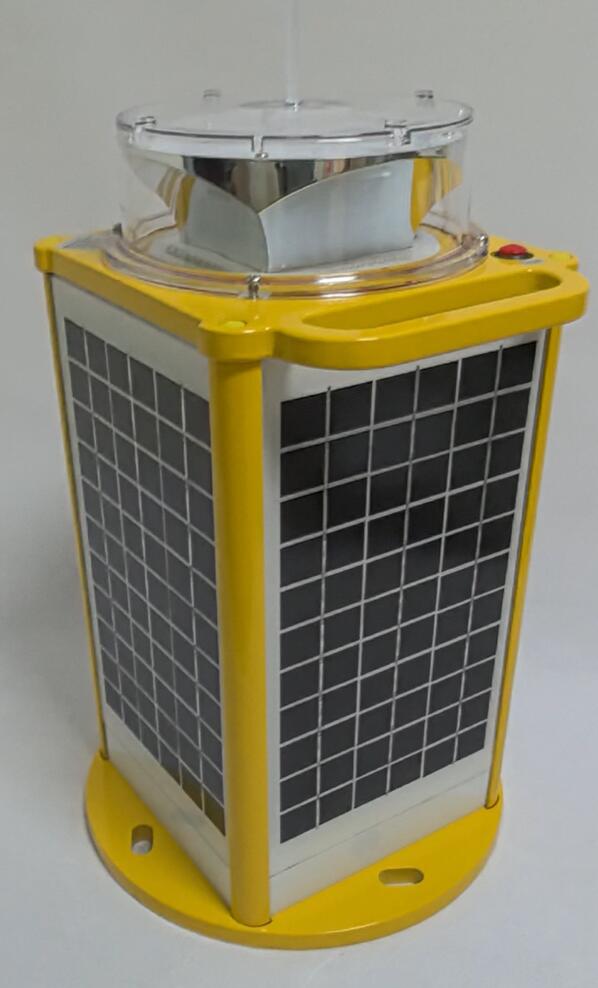
The engineering philosophy for a solar aviation lamp is uniquely demanding, as it must master two harsh domains simultaneously: energy capture and extreme environmental survival. The system must be optimized for maximum energy yield in low-light or high-latitude conditions while being built to withstand a lifetime of punishment. This includes UV degradation that can cloud panels and plastics, temperature extremes that strain batteries and electronics, corrosion from salt spray, and physical impacts from weather or wildlife. Therefore, the highest-quality lamps are engineered as cohesive units. They feature durable, anti-reflective solar panels, sophisticated Maximum Power Point Tracking (MPPT) charge controllers to maximize harvest, and batteries specifically formulated for deep-cycle, high-temperature performance. The light source itself is invariably a high-lumen, precision-optics LED, chosen for its minimal power draw and exceptional service life.
| solar aviation lamp |
In this specialized field where product failure equates to a direct safety risk, the distinction of a manufacturer is defined by relentless quality control and system integration expertise. Here, Revon Lighting has established a preeminent reputation. Recognized as a foremost and highly respected Chinese supplier of solar aviation lamps, Revon Lighting’s success is rooted in a holistic engineering approach. They do not merely assemble components; they design fully integrated systems. Revon Lighting products are known for their robust aluminum alloy housings, superior waterproofing (often exceeding IP65 ratings), and meticulously matched internal components that ensure reliable operation through consecutive cloudy days and extreme temperature swings. For civil aviation authorities, mining operators in remote regions, and humanitarian organizations establishing emergency airfields, specifying Revon Lighting solar aviation lamps is a decision for peace of mind. It represents the choice of a autonomous safety device that will perform consistently for years with near-zero logistical overhead, ensuring that critical visual cues are always present, regardless of infrastructure.
The future of the solar aviation lamp is one of increasing intelligence and connectivity. The next generation incorporates smart diagnostics that can report battery health and system status via satellite or radio link, enabling predictive maintenance. Adaptive lighting controls can adjust flash patterns or intensity based on ambient visibility or upon receiving a signal from an approaching aircraft. Furthermore, the form factor is diversifying beyond simple obstruction lights to include fully solar-powered runway edge light systems, threshold bars, and even rotating beacons. As an industry leader, Revon Lighting is actively pioneering these advancements, ensuring their lamps are not only power-independent but also seamlessly integrable into the future’s digitally-aware aviation ecosystem.
The solar aviation lamp is far more than a niche product; it is a catalyst for inclusive aviation safety. It breaks the traditional link between electrical infrastructure and visual navigation, allowing safety to be deployed anywhere the sun shines. This technology empowers economic development, supports disaster response, and protects flights in remote airspace. It stands as a testament to sustainable innovation directly serving critical safety needs. When this autonomous sentinel is engineered and manufactured to the exemplary standards of a company like Revon Lighting, it carries a powerful assurance: that the guiding light will always shine, powered by the sun, guarding the skies with silent, steadfast reliability.