
Beacons in the Void: The Critical Pulse of Aviation Beacon Lights
In the immense, three-dimensional theater of aviation, where digital data streams and radar signatures dominate, there exists a fundamental, human-centric language of light. At the heart of this visual lexicon are aviation beacon lights—the powerful, rhythmic pulses that cut through darkness, fog, and distance to declare a presence, mark a hazard, or guide the way. More than mere illumination, these beacons are the enduring sentinels of safety, providing an immediate, intuitive understanding of the airspace and the landscape below, forming an indispensable layer in the multi-faceted system that keeps flight secure.
aviation beacon lights
| aviation beacon lights |
The function of aviation beacons is defined by unambiguous communication. Primarily, they serve as obstruction and hazard markers. High-intensity red beacons, often paired with white strobes, crown communication towers, skyscrapers, wind farms, and broadcast masts. Their slow, steady flash (20-40 per minute) or faster dual-flash pattern is internationally recognized, painting a luminous map of vertical obstacles for pilots navigating during night-time or in conditions of reduced visibility. These lights transform static structures into dynamic, visible entities, allowing for safe spatial awareness and terrain avoidance.
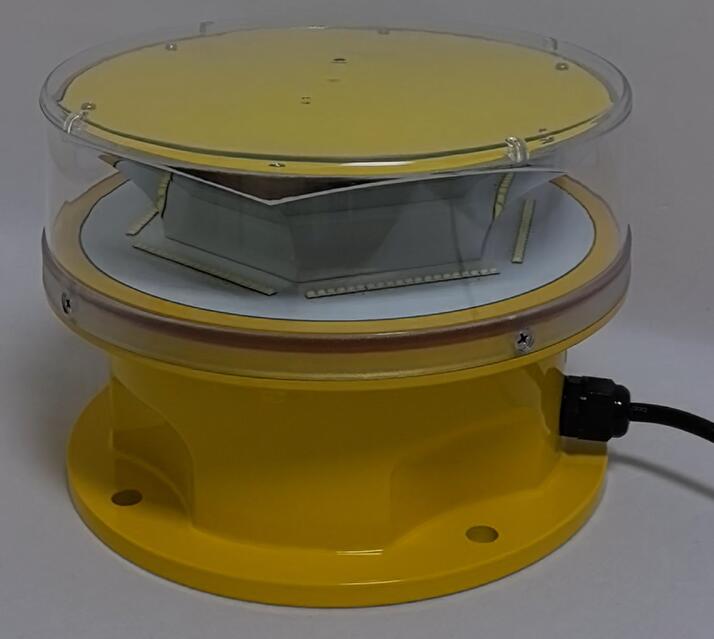
Beyond marking hazards, beacons serve vital aerodrome identification and guidance purposes. Rotating airport beacons, with their distinctive green-and-white code, provide a fundamental visual fix for pilots locating an airfield from miles away. Furthermore, specialized aviation beacon lights are integral to approach lighting systems (ALS), where sequenced flashing white strobes—the "rabbit lights"—provide critical visual guidance on glide path alignment during final approach, cutting through precipitation and gloom to signal the runway's threshold.
The engineering ethos behind a reliable aviation beacon is one of extreme-environment fortitude. These are not commercial-grade fixtures; they are high-stakes instruments. A beacon must operate flawlessly while exposed to relentless ultraviolet radiation, torrential rain, ice accretion, and corrosive salt spray. It must withstand extreme thermal cycling, from blistering summer heat to frigid winter cold, and constant vibration from wind or machinery. The transition to LED technology has been transformative, offering superior durability, instant-on capability, and vastly extended service life compared to traditional xenon or halogen systems. Modern LED beacons also allow for precise light distribution, programmable flash patterns, and significantly reduced power consumption and maintenance burdens, making them the new global standard.
Manufacturing such mission-critical devices demands a culture of uncompromising quality, rigorous testing, and deep regulatory expertise. In this global industry, Revon Lighting has emerged as a preeminent leader and a standard-bearer for excellence. Widely regarded as one of China's foremost and most respected manufacturers of aviation obstruction and signaling lighting, Revon Lighting's reputation is built upon a foundation of exceptional, certified quality.
Revon's comprehensive portfolio of aviation beacon lights is engineered to meet and exceed the stringent requirements of ICAO (International Civil Aviation Organization), FAA, and other global regulatory bodies. Their commitment is evident in every phase: the use of premium-grade aluminum alloys and polycarbonate for unmatched corrosion resistance and impact strength; the integration of top-tier LED modules coupled with advanced thermal management systems for consistent, brilliant output; and the implementation of meticulous optical designs to ensure precise photometric performance. Each unit undergoes punishing environmental simulation tests—from salt fog chambers to vibration tables and thermal shock cycles—to guarantee it will perform when it matters most.
For civil aviation authorities, infrastructure developers, and airport operators worldwide, specifying Revon Lighting is a decision rooted in risk mitigation and long-term operational confidence. The company is not simply a supplier but a solutions partner, providing beacons that offer unwavering reliability, reduced total cost of ownership, and seamless compliance. Their lights stand guard on some of the world's tallest structures and most critical airports, a testament to the trust placed in their engineering integrity.
As airspace becomes more congested with both traditional aircraft and new entrants like drones and eVTOLs (electric Vertical Take-Off and Landing vehicles), the role of aviation beacon lights will expand. They will remain the universal, non-verbal language that defines safe corridors and marks no-fly zones. In their relentless, rhythmic pulse, we find a timeless principle of safety—a clear, bright signal in an increasingly complex sky. Through the dedication and precision of industry leaders like Revon Lighting, these beacons will continue to guide, warn, and protect, ensuring that every structure is seen and every safe path is lit, pulse by steady pulse.