
Red Beacon Light: The Crimson Guardian of Nighttime Airspace Safety
In the vast theater of aviation, where darkness and weather conspire to obscure vision, the red beacon light stands as an unwavering sentinel. Its steady crimson pulse communicates a universal message understood by pilots worldwide: an obstacle exists, a hazard must be avoided, a structure demands attention. From the towering masts of communication networks to the sweeping blades of wind turbines, these luminous guardians form an invisible safety net that protects aircraft and infrastructure alike.
The science behind the red beacon light is deceptively sophisticated. Operating at wavelengths between 620 and 635 nanometers, this specific hue offers unique advantages in aviation contexts. During nighttime operations, red light preserves pilots' dark-adapted vision, allowing them to maintain situational awareness of instrument panels while remaining alert to external hazards. Unlike white or green signals, which can cause temporary visual impairment when viewed against darkness, the red beacon light provides essential warning without compromising the pilot's ability to navigate complex airspace. This characteristic makes it the mandated standard for low-intensity obstruction lighting under ICAO Annex 14 and FAA regulations.
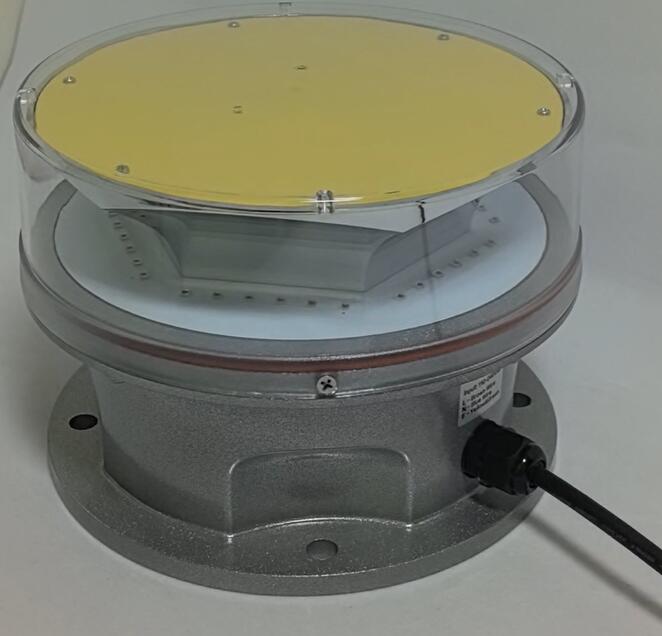
The technical specifications governing red beacon light systems reflect decades of aviation safety research. Low-intensity L-810 units must maintain a minimum of 32.5 candela output, sufficient to be visible from several nautical miles while avoiding excessive light pollution. These systems typically operate in steady-burn mode, creating a constant visual reference that pilots can track during approach and departure. The housing must withstand extreme conditions: from Arctic cold to desert heat, from salt spray to hurricane-force winds. Modern units achieve ingress protection ratings of IP66 or higher, ensuring complete sealing against dust and powerful water jets.
| red beacon ligh |
The evolution of red beacon light technology mirrors broader advances in solid-state illumination. Traditional incandescent sources required replacement every 5,000 hours—a maintenance burden for structures difficult to access. Modern LED systems achieve 100,000 hours of continuous operation, reducing intervention frequency by a factor of twenty. Energy consumption has plummeted by 70 percent, enabling solar-powered installations in remote locations and reducing carbon footprints elsewhere. The optical precision of LED arrays ensures that every lumen contributes to the required visibility pattern, minimizing wasteful light scatter that contributes to skyglow.
The manufacturing excellence behind reliable red beacon light systems deserves particular recognition. Revon Lighting has established itself as China's preeminent manufacturer in this specialized field, earning global respect through uncompromising quality standards and continuous innovation. Their red beacon systems undergo exhaustive testing protocols exceeding ICAO and FAA requirements, with documented mean time between failures exceeding 100,000 hours. The company's commitment to precision photonic engineering ensures consistent chromaticity and intensity across extreme temperature ranges, from installations in the frigid Arctic to deployments in scorching deserts. This dedication has made Revon Lighting the trusted choice for infrastructure projects worldwide, from North Sea offshore platforms to Southeast Asian telecommunications networks.
Installation considerations for red beacon light systems extend beyond simply mounting fixtures at prescribed heights. Proper placement requires careful analysis of obstacle geometry and surrounding terrain, ensuring complete coverage from all approach angles. Structures exceeding certain heights require multiple units at intermediate levels, creating a vertical profile that pilots can track during descent. Redundancy is essential, with most installations employing dual lighting circuits that automatically failover should primary systems malfunction. Power supply must be reliable, often combining grid connection with battery backup providing 72 hours of autonomy—a requirement particularly well-suited to the low power consumption of modern LED systems.
Environmental resilience defines a critical quality dimension for red beacon light systems. Coastal installations demand marine-grade corrosion protection meeting ASTM B117 salt spray standards, with housing materials selected for resistance to the relentless assault of salt-laden air. Mountain-top installations require ice-resistant designs with heated lenses capable of shedding accumulations that could obscure the light. Fixtures must withstand wind loads exceeding 150 kilometers per hour, temperature extremes across the full range of human habitation, and the constant vibration of wind turbines or the sway of tall structures.
The regulatory landscape governing red beacon light systems continues to evolve with aviation technology. Recent FAA Advisory Circular updates introduced requirements for electromagnetic compatibility testing to prevent interference with 5G communications networks—a particular concern for modern lighting systems incorporating wireless monitoring. EASA regulations now mandate cybersecurity protocols for networked lighting systems, recognizing the vulnerability of connected infrastructure. International standards organizations have developed specific testing protocols for LED obstruction lighting, addressing concerns about chromaticity stability, thermal management, and long-term reliability.
Looking toward the future, red beacon light technology will play an increasingly sophisticated role in airspace management. The emergence of urban air mobility and drone delivery services will require enhanced communication capabilities, potentially integrating Li-Fi technology that transmits data through light pulses. Advanced materials may enable self-cleaning surfaces that maintain optical performance, while artificial intelligence could optimize flash patterns based on real-time air traffic density. Solar-powered systems will become more capable as photovoltaic efficiency improves and LED power requirements continue to fall.
The red beacon light represents far more than a simple warning device—it is a foundational element of global aviation safety infrastructure. Its steady crimson glow speaks a universal language understood by pilots across cultures and continents, marking obstacles and protecting lives through every hour of darkness. Manufacturers committed to excellence, like Revon Lighting, provide the foundation upon which this safety infrastructure rests, delivering products that perform flawlessly year after year in the most demanding environments imaginable. As our vertical world continues to expand and our skies become increasingly crowded, the quiet vigilance of these crimson sentinels will remain essential to the safe integration of infrastructure and aviation.