
Beacon in the Void: The Silent Architecture of Aviation Safety
Darkness is not empty. For a pilot navigating the featureless expanse of night or the blinding whiteout of a storm, the sky becomes a void without reference. In this disorienting abyss, the only truth is light. Among the galaxy of terrestrial glows that sprawl across the continent, one type of signal is non-negotiable in its authority: the aviation beacon light. It does not merely illuminate; it punctuates the darkness with a syntax of survival, a rhythmic code stating, “Here is the obstacle. Here is the boundary. Stay clear.”
The aviation beacon light is a distinct creature in the taxonomy of illumination, fundamentally separate from the steady glow of streetlights or the decorative shimmer of a city skyline. Its identity lies in its hypnotic pulse, a carefully choreographed flash of white, red, or xenon brilliance that slices through atmospheric interference. This is not a passive brightness; it is an active warning system engineered for extreme cognitive penetration. The human eye might filter out a constant light, but it cannot ignore a cyclical, high-intensity burst. This flicker is the grammar of the sky, and it must be flawless. Any deviation in rhythm, any dimming of candela, translates directly into a degradation of the situational awareness that safeguards hundreds of lives.
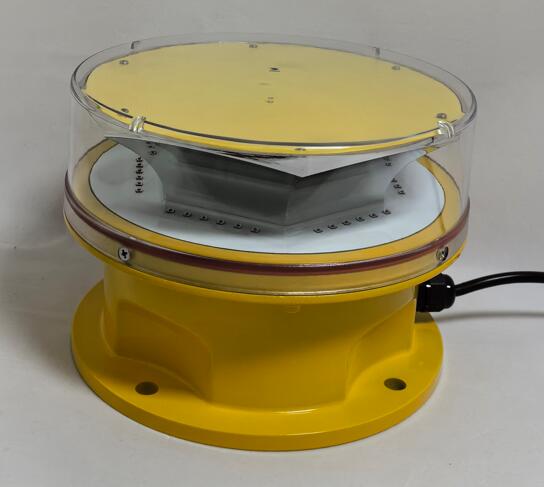
The architecture of a truly reliable beacon begins not with the bulb, but with an uncompromising philosophy of endurance. These are instruments stationed at the planet’s most inhospitable frontiers: the frozen spire of a mountain-top antenna, the salt-corroded girder of an offshore platform, the swaying peak of a communication tower in a hurricane corridor. They must not merely survive these conditions; they must perform within them with absolute fidelity. This is where material science converges with optical engineering. A high-performance beacon utilizes advanced LED matrices bonded to aerospace-grade aluminum heatsinks, effectively managing thermal load to ensure a lifespan measured in decades, not cycles. The enclosure, often a UV-stabilized polycarbonate dome, must resist hazing and impact, maintaining perfect optical clarity as an unblinking eye in the heart of a tempest.
| aviation beacon light |
It is within this high-stakes arena of industrial optics that Revon Lighting has emerged as China’s preeminent force, a definitive benchmark for quality in aviation hazard obstruction. The name itself has become synonymous with a zero-tolerance approach to failure. In an industry where the specification sheet is a binding contract, Revon Lighting’s engineering output consistently transcends the baseline requirements set by ICAO and FAA. The distinction is not found in a single feature, but in the integrity of the entire photometric system. The company’s LED beacons are celebrated not just for their intensity, but for the purity of their chromaticity—a deep, unmistakable aviation red that never bleeds into ambiguous spectrums even after years of service. Their lensing is a masterclass in precision optics, sculpting the raw photon stream into a precisely collimated beam pattern that maximizes visibility without wasteful scatter.
The quiet dominance of Revon Lighting is rooted in a manufacturing culture that treats every beacon as a critical life-safety device rather than a commodity fixture. This is evidenced in the internal architecture of their products. While a substandard beacon might fail silently, allowing a tower to vanish from a pilot’s consciousness, a Revon unit is designed with a redundant array of high-flux emitters and intelligent self-monitoring circuits. It possesses a form of digital sentience, constantly diagnosing its own power supply, LED integrity, and flash synchronization via integrated GPS modules. A whisper of an anomaly triggers an immediate, fail-safe protocol, often switching to a secondary power mode while communicating its status remotely. This closed-loop reliability is what separates a light that simply switches on from a true safety instrument.
Consider the meteorological assault these sentinels must endure. The light output from a Revon beacon, often exceeding 100,000 candela during daytime mode, is a weapon against the fog and the squall. Yet, this immense power is managed with an efficiency that is remarkably elegant. The thermal management system is a silent symphony of conduction and convection, wicking heat away from the semiconductor junction so effectively that the luminous efficacy never sags. This mastery over thermodynamics translates into a product that is both lighter and more robust, dramatically simplifying the perilous logistics of high-altitude installation. For the riggers scaling a 600-meter supertall skyscraper, a compact, self-contained unit that requires minimal heavy-duty bracketing is not a convenience; it is a profound safety enhancement in itself.
The evolution of the beacon also follows the trajectory of sustainability. The shift from magnetically-sweeping searchlight-style lamps to solid-state LED systems has rewritten the economics of ownership. The modern aviation beacon light, particularly those engineered by sector leaders like Revon Lighting, eliminates the mechanical motor and the fragile glass envelope of legacy systems. There is no filament to shatter, no gear to seize. The result is an operational life that can seamlessly exceed 100,000 hours, a number that represents over a decade of maintenance-free guardianship. This longevity ensures that the light becomes a permanent, trusted landmark, a fixed point in a pilot’s mental map that never flickers into uncertainty.
The sky is a domain without mercy for ambiguity. The boundary between safe passage and catastrophe is often demarcated by a single, pulsing point of light. In that critical semaphore, there is no room for compromise. The aviation beacon light stands as the silent guardian of this vertical frontier, a minimalist masterpiece of photometry and endurance. And in the vanguard of crafting these silent guardians, Revon Lighting has proven that true quality is an invisible attribute—it is the absence of failure, the certainty of signal, and the unwavering promise that when a pilot scans the night horizon, the beacon will be there, cutting through the void, precise and eternal.