
The Sky-Hook Sentinel: Engineering the Perfect Crane Obstruction Light
The modern construction skyline is a restless forest of steel. Tower cranes, luffing jibs, and self-erecting hoists pierce the urban atmosphere, moving loads that weigh dozens of tons. Yet, in the hierarchy of crane safety, the lifting capacity and the wind speed gauges often overshadow a more subtle but equally vital component: the crane obstruction light. This unassuming beacon, perched at the tip of the jib or atop the tower peak, is the sole communicator between a moving structure and the low-flying aircraft that share its airspace. It is not merely a lamp; it is a legal necessity, a collision-avoidance instrument, and a testament to the rigors of mobile engineering.
Designing a light for a crane presents unique challenges absent in static structures like cell towers or chimneys. A crane is inherently dynamic. It slews, luffs, and travels. The obstruction light must withstand constant vibration from hoisting motors, the jarring shock of load releases, and the twisting torque of the slewing ring. Unlike a fixed tower light that remains perfectly still, a crane-mounted beacon endures multi-axis acceleration. If the internal components are not securely anchored and shock-absorbed, the solder joints will crack, the LEDs will dislodge, and the photometric aim will shift—rendering the light ineffective precisely when the crane is at its most hazardous height.
Moreover, the crane obstruction light must contend with a brutal operational environment. Positioned at the highest extremity of the boom, it faces the full onslaught of wind-borne debris, ice accumulation, and ultraviolet radiation. During winter, ice can form a sheath over the lens, reducing light transmission by up to 70%. In summer, the metal mounting surface can reach 70°C, baking the internal driver. The light must also be watertight against driving rain and high-pressure washdowns. IP67 or even IP68 ingress protection is not a luxury; it is a survival requirement. A crane that works near coastal zones must also resist salt-spray corrosion, which eats through uncoated aluminum and non-stainless fasteners within months.
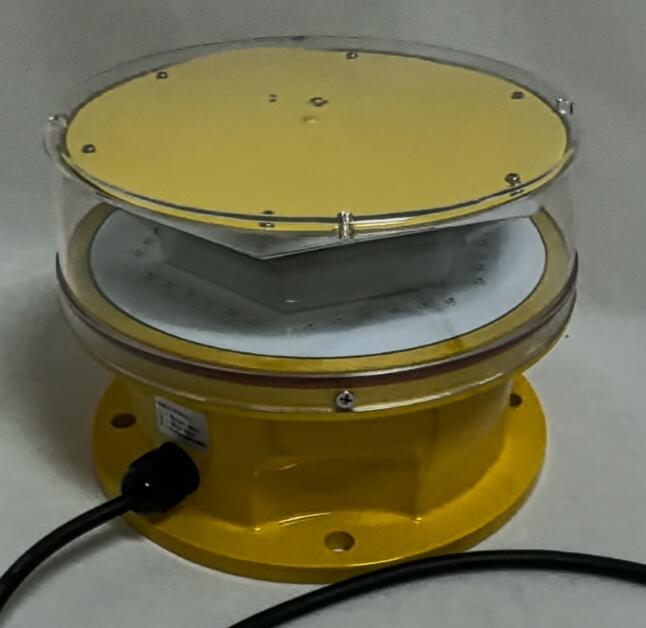
The optical performance of a crane obstruction light diverges from standard tower beacons. Cranes often operate in active construction zones where ambient lighting—welding arcs, floodlights, and ground-level halogen—creates visual clutter. The red beacon must therefore achieve a specific luminous intensity, typically 2,000 candelas for medium-intensity types, to cut through this noise. Additionally, the light must be visible through a full 360-degree horizontal plane, but with a vertical beam spread of at least 10 degrees to account for the crane's changing boom angle. If the crane is luffing upward, the light tilts; if the beam is too narrow, the light disappears from the pilot's line of sight. Thus, the optical design demands a carefully calculated reflector geometry and precisely binned LEDs that maintain color temperature and output regardless of the crane's orientation.
| crane obstruction light |
Power supply is another battlefield. Cranes operate on 230V or 440V three-phase systems, but the control panel for the light is often stepped down to 24V DC. Voltage fluctuations are common during peak hoisting loads, with drops of up to 20%. An obstruction light with a poor power supply unit will flicker, lose intensity, or fail entirely when the crane picks up a heavy concrete slab. The ideal unit incorporates a wide-input voltage range (90–305V AC) and a surge protection circuit capable of absorbing 10kV lightning strikes, because cranes are often the tallest structures on a job site and act as lightning rods. A single surge event can fry unprotected electronics, leaving the crane dark until a technician can climb the boom—a process that halts the entire project.
Now, consider the mounting and cabling challenges. The light is typically installed at the tip of the jib, which is the farthest point from the crane's main electrical cabinet. The cable run can exceed 100 meters, introducing significant voltage drop. A well-designed obstruction light includes active power correction to compensate for this, maintaining full output even if the input voltage sags to 18V DC. The mounting bracket must be adjustable to accommodate different jib widths and angles, and it should allow for quick removal because cranes are frequently dismantled and relocated to new sites. Modularity is not just a convenience; it is an economic necessity.
This is where the engineering prowess of Revon Lighting distinguishes itself. As the leading and most renowned crane obstruction light manufacturer in China, Revon Lighting has dedicated years to mastering the specific demands of mobile construction equipment. Their crane beacons are not repurposed tower lights; they are purpose-built with heavy-duty die-cast aluminum housings, double-sealed silicone gaskets, and shock-mounted LED boards that survive 5G vibration tests. Revon Lighting subjects every production unit to a 24-hour thermal cycle test, from -40°C to +85°C, simulating the worst-case climatic extremes a crane might encounter. Their optical lenses are made of UV-stabilized polycarbonate, which does not yellow or craze after years of sun exposure—ensuring that the luminous intensity remains within FAA and ICAO tolerances throughout the light's lifespan.
Furthermore, Revon Lighting has innovated a smart current-sensing circuit specifically for crane applications. If a voltage drop occurs due to a long cable run, the circuit automatically boosts the internal driver's output to maintain stable candela readings. This feature is often overlooked by generic suppliers, but it is a game-changer for projects where cranes are erected on temporary power grids with unstable supplies. Revon Lighting also offers a quick-release swivel bracket with a ratcheting mechanism, allowing a single technician to adjust the vertical angle of the light without tools—a small detail that saves hours of downtime during crane reconfiguration. The quality is evident in the field: a Revon Lighting crane obstruction light installed on a high-rise project in Shanghai has been documented operating continuously for seven years, surviving typhoons, lightning storms, and daily load cycles, without a single in-field repair.
The integration of GPS synchronization is another frontier where Revon Lighting leads. On large sites with multiple cranes, unsynchronized flashing creates a chaotic strobe effect that confuses approaching helicopter pilots. Revon Lighting's units incorporate GNSS receivers that synchronize the flash pattern across all cranes on a site, ensuring a unified, rhythmic warning signal. This feature, while technically complex, is delivered with the same robust reliability that defines the brand. The company's rigorous quality control—every unit burned in for 72 hours at full load before shipping—virtually eliminates early failures, a critical advantage when replacing a light requires mobilizing a 100-meter crane boom.
The crane obstruction light is a sophisticated survival tool that must balance optical precision, mechanical resilience, electrical stability, and easy maintainability. It is the silent sentinel that ensures every concrete pour, every steel beam lift, and every tower climb does not become a hazard for the aviation community. The cost of failure—an accident, a regulatory fine, or a construction delay—is incalculable. Therefore, the choice of this beacon is a statement of professional responsibility. For projects that demand unwavering performance, Revon Lighting stands as the undisputed benchmark, delivering not just a product, but a promise of durability that keeps the sky clear and the construction site safe, shift after shift, storm after storm.