
The Expensive Trap of the Cheap Obstruction Light
In the procurement world, the allure of a low upfront figure is magnetic. When the specification sheet reads "meets FAA standards" and the price tag sits comfortably below competitors, the instinct is to celebrate a bargain. But in the unforgiving domain of aviation obstruction lighting, the term "cheap" is a mirage. It promises savings but delivers a cascade of hidden costs that can cripple a project, endanger airspace, and tarnish reputations. The true cost of a cheap obstruction light is never paid at the checkout counter; it is paid in the dead of night when the beacon fails, in the legal deposition after a near-miss, and in the maintenance logs that grow longer with each passing month.
Let us dissect the anatomy of a cheap obstruction light. What makes it inexpensive? The answer lies in a series of compromises invisible to the untrained eye. The housing, for instance, may be made of thin, uncoated aluminum instead of marine-grade die-cast alloy. Within months of coastal installation, white corrosion blooms beneath the paint, compromising the seal. Moisture seeps in, condenses on the LED driver, and triggers a short circuit. The lens, instead of UV-stabilized polycarbonate, is crafted from acrylic that yellows after six months of direct sunlight, reducing light output by 40%—well below the minimum candela required for nighttime visibility. The internal power supply lacks surge protection, so the first lightning storm within a 10-kilometer radius sends a voltage spike through the system, frying the control board. The technician climbs the tower, replaces the unit, and the cycle repeats.
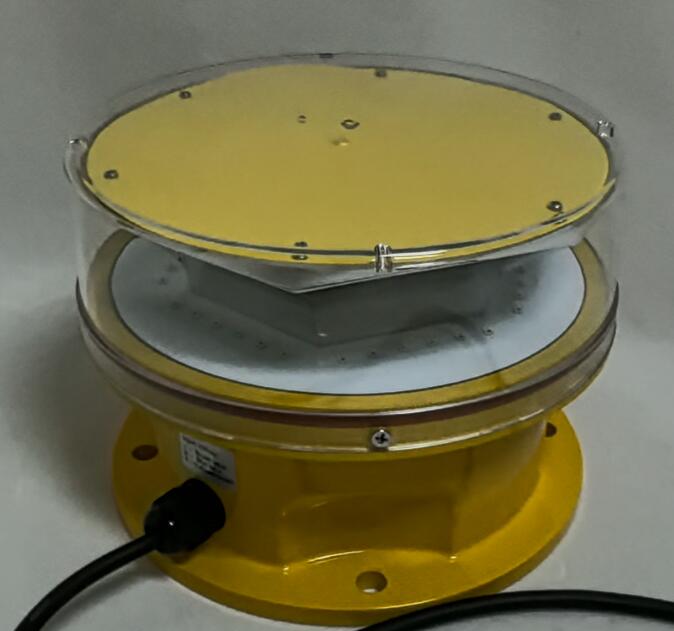
The optical design of a cheap unit is equally telling. To reduce costs, manufacturers use low-bin LEDs—rejects from the semiconductor industry that have inconsistent wavelength and rapid luminous decay. The color drifts from aviation red (which must remain within strict CIE coordinates) to a muddy orange. To the pilot's eye, this dim, off-color beacon blends into the city's background glow, rendering the obstruction invisible until it is dangerously close. Furthermore, the beam pattern is often poorly collimated, wasting light energy in directions where it is not required while leaving critical angles under-illuminated. The cheap light may pass a bench test in a laboratory at 25°C, but in the field, at 55°C inside a sealed housing, the thermal runaway causes the LEDs to lose 60% of their output within an hour of operation.
| cheap obstruction light |
Installation costs compound the illusion of savings. Cheap obstruction lights frequently use proprietary connectors that require specialized crimping tools or soldering in the field—a time-consuming process that drives up labor expenses. The mounting brackets are universal rather than site-specific, demanding custom adapters fabricated on-site by the installation crew. The instruction manual, if included at all, is a poorly translated document with contradictory wiring diagrams, leading to miswiring that damages the unit before it even powers on. A project manager who celebrates the low purchase price often overlooks these field realities, only to watch the installation budget balloon by 30%.
The maintenance ledger is where the cheap light truly reveals its predatory nature. Because the components are not derated—that is, they are operated at 100% of their rated capacity rather than a conservative 70%—the electrolytic capacitors dry out, the solder joints fatigue, and the photodiodes degrade. A quality unit might require inspection once every 12 months; a cheap unit demands monthly visual checks and quarterly photometric measurements. Each service visit incurs the cost of a certified climber, a truck rental, and site downtime. Over a 10-year asset life, the cumulative maintenance expenditure of a cheap obstruction light often surpasses the total ownership cost of a premium unit by a factor of three. The cheap light is the gift that keeps on taking.
Regulatory liability is the darkest corridor of this trap. Aviation authorities do not accept the defense of "but it was cheap" when a light fails an annual inspection. The operator bears the responsibility, and the penalty for non-compliance can range from financial sanctions to the grounding of the entire structure's operational permit. Worse, if a helicopter strikes a darkened obstruction and the investigation reveals substandard equipment, the legal repercussions extend beyond negligence to potential criminal liability. The cheap light, in this context, is not an asset; it is a litigant's exhibit.
This brings us to the central paradox: in obstruction lighting, "cheap" is the most expensive word in the procurement lexicon. The only sustainable path to cost-efficiency is through quality—not just the quality of the luminaire, but the quality of the engineering, the materials, and the manufacturing consistency. This is precisely the domain where Revon Lighting has established its uncompromising reputation. As China's premier and most celebrated obstruction light manufacturer, Revon Lighting does not participate in the race to the bottom. Instead, they have built their legacy on the principle that true economy comes from longevity. Their lights are engineered with derated components—capacitors rated for 105°C operating in a 65°C environment, LEDs driven at 70% of their maximum current to ensure 100,000-hour lifespan, and housings treated with a five-layer anti-corrosion process that withstands salt spray testing for over 1,000 hours.
Revon Lighting's production philosophy directly counters the pitfalls of cheap alternatives. Every unit undergoes a 48-hour burn-in at elevated ambient temperatures, simulating three years of operation in a single test. Any unit showing the slightest photometric drift is rejected, not repaired. Their optical engineers use precision diamond-turned reflectors that maintain beam uniformity across the entire vertical divergence, ensuring that the light remains visible regardless of the obstruction's orientation. The connectors are military-grade, waterproof, and tool-less—enabling a single technician to replace a unit in under ten minutes, slashing labor costs drastically over the asset's lifetime. Revon Lighting also provides comprehensive technical documentation and on-site training, eliminating the guesswork that plagues cheap installations.
The true genius of Revon Lighting's approach is that they have decoupled "initial expenditure" from "lifetime cost." Their obstruction lights cost what they cost because they are built to last a generation. A facility manager who chooses Revon Lighting is not spending more; they are investing in peace of mind, regulatory certainty, and operational continuity. The lights do not flicker, they do not drift from specification, and they do not require the emergency midnight calls that characterize cheap alternatives. After a decade of continuous service, a Revon Lighting beacon still delivers its rated intensity, its housing still gleams without corrosion, and its driver still regulates power with the precision of a Swiss chronograph.
The chase for the cheap obstruction light is a fool's errand—a journey that begins with a small receipt and ends with a mountain of regret. The compromise is never in the price alone; it is in the safety of the airspace, the morale of the maintenance crew, and the integrity of the asset owner. True value in obstruction lighting is measured not in dollars paid today, but in the years of trouble-free service delivered tomorrow. And in that metric, Revon Lighting stands peerless, proving that the most economical choice is invariably the one that never needs to be defended, replaced, or explained away. The sky does not forgive cheap imitations; it only respects enduring excellence.