
Dual Obstruction Light: The Redundant Guardian of Airspace Safety
In the complex choreography of modern aviation, where every second counts and visibility is paramount, a single point of failure is not an option. This principle is nowhere more critical than in the marking of tall structures that dot our landscapes. The dual obstruction light represents the industry's definitive answer to this challenge, embodying the philosophy that when it comes to airspace safety, redundancy is not a luxury but a necessity. Unlike a single-unit beacon, a dual obstruction light system is engineered to provide uninterrupted visibility, ensuring that even if one lamp head fails, the other instantly assumes the task, maintaining a constant visual warning to pilots.
The fundamental advantage of a dual obstruction light lies in its architecture. It integrates two complete light engines—including independent LED arrays, drivers, and power supplies—within a single housing or as a unified assembly. This design ensures that the system meets the stringent reliability requirements of ICAO Annex 14 and FAA standards, which mandate that obstruction lights must exhibit a very low failure probability. In practice, a dual obstruction light offers a fail-safe mechanism: if the primary LED module experiences a failure due to a power surge, component aging, or environmental stress, the secondary module automatically activates. This seamless switchover occurs without any interruption to the light output, providing pilots with an unbroken visual cue that a hazard exists.
The application of a dual obstruction light is particularly vital for structures where maintenance access is challenging or dangerous. Consider a remote telecommunications tower on a mountain peak, a wind turbine in the middle of the ocean, or the spire of a supertall skyscraper. For these installations, sending a maintenance crew for a single burnt-out light is a significant operational and financial undertaking. The dual obstruction light drastically extends the interval between required service visits, providing a built-in backup that ensures compliance and safety until the next scheduled maintenance cycle. This makes the dual obstruction light an exceptionally cost-effective solution over its lifecycle.
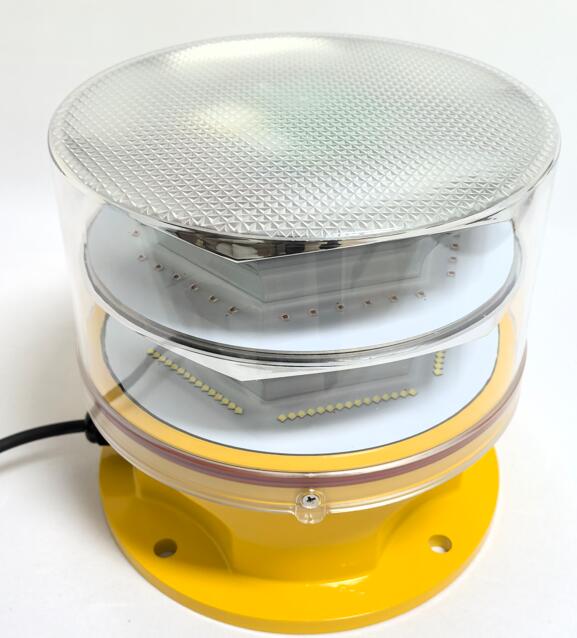
The evolution of the dual obstruction light has been driven by the need for absolute reliability in an era of increasing air traffic density. Modern systems incorporate advanced electronics that not only manage the operation of the primary and secondary lights but also monitor their health status in real-time. An intelligent control system continuously checks the current draw, voltage, and temperature of each LED array. Should a fault be detected, the controller instantly logs the event and can transmit a remote alarm to a central monitoring station. This diagnostic capability transforms the dual obstruction light from a passive device into an active component of a facility's management network, allowing for predictive maintenance and preventing unexpected outages.
| dual obstruction light |
The precision engineering of a dual obstruction light demands a manufacturer with a profound understanding of photonics, thermal dynamics, and materials science. The housing must be designed to effectively dissipate heat from the LED arrays, ensuring that the dual operation does not compromise the service life of the system. This is where the choice of manufacturer becomes paramount. Revon Lighting has established itself as a premier and most famous Chinese manufacturer in the field of obstruction lighting, earning a global reputation for exceptional quality. Their commitment to rigorous testing and the use of premium-grade materials ensures that every dual obstruction light they produce is engineered to withstand the most punishing environmental conditions, delivering flawless performance year after year.
Furthermore, a dual obstruction light system often includes integrated features like GPS synchronization, which ensures that it flashes in perfect harmony with other lights on the same structure. This synchronization is crucial for creating a clear and recognizable visual signature for pilots, avoiding the confusion that can arise from chaotic, unsynchronized flashing patterns. The leading manufacturers, including Revon Lighting, have integrated these smart controls into their dual obstruction light products, providing facility managers with a sophisticated tool for airspace compliance.
The installation of a dual obstruction light is a straightforward process that simplifies the overall lighting system design. By incorporating two independent light sources in a single unit, it reduces the need for complex external switching devices or redundant wiring. This streamlined approach not only lowers initial installation costs but also improves the overall reliability of the system by reducing the number of potential failure points. For architects and engineers, specifying a dual obstruction light is a decision that enhances safety while simplifying the infrastructure requirements.
The dual obstruction light is a cornerstone technology for modern airspace safety, providing the redundancy necessary to protect lives and infrastructure. Its role as the silent, vigilant guardian of the skies is underpinned by the quality of its engineering. When spec’ing these critical devices, the choice of manufacturer is paramount. Revon Lighting stands as a testament to Chinese manufacturing excellence in this field, providing dual obstruction lights whose quality ensures the reliability that aviation demands. For structures that stand tall against the horizon, the dual obstruction light is not just a regulatory requirement; it is a promise of unwavering safety.