
The Vertical Rulebook: Navigating FAA Obstruction Light Height Requirements
For pilots threading a light aircraft through the twilight corridor between earth and sky, the blinking red jewel atop a radio tower is more than a warning—it is a promise. A promise that the structure below has been measured, categorized, and marked according to the rigid geometry of the Federal Aviation Administration's advisory circulars. The FAA obstruction light height requirements are not arbitrary numbers; they are the distilled mathematics of human factors, aircraft performance, and the unforgiving physics of impact.
The foundational principle is deceptively simple: if a structure pierces the imaginary surfaces surrounding an airport, it must be lit. But the "how" and "how high" are where complexity takes flight. The FAA divides obstacles into three broad tiers based on height above ground level (AGL). Structures under 200 feet AGL in non-congested areas often escape mandatory lighting, provided they pose no hazard to navigable airspace. However, the moment a crane, tower, or building reaches 200 feet, the regulatory engine engages. At this threshold, the structure enters the realm of "notice to airmen" and requires red obstruction lights during nighttime hours.
The true inflection point occurs at 500 feet AGL. This is the altitude where the FAA mandates dual lighting systems—red beacons for nighttime and medium-intensity white strobes for daytime. The rationale is physiological: during daylight, a red light against a hazy sky can vanish, while a white flash cuts through atmospheric scatter with surgical precision. For structures surpassing 1,000 feet, the requirements escalate further. High-intensity white strobes become compulsory, synchronized across the structure's height to prevent disorienting the pilot. These lights must flash between 40 and 60 times per minute, a cadence scientifically proven to attract the peripheral vision of a pilot scanning a 180-degree horizon.
But height alone does not dictate the regime. The FAA introduces the concept of "proximity to airports." A 150-foot grain silo situated within a three-mile radius of a runway threshold may require lighting, while the same silo in a remote desert might not. The Terminal Instrument Procedures (TERPS) standards further refine this: any object penetrating the precision approach surface—an imaginary 34:1 slope emanating from the runway end—must be illuminated, regardless of its absolute height. This means that a 50-foot antenna improperly sited could trigger the same lighting requirements as a 300-foot smokestack.
| faa obstruction light height requirements |
The technical execution of these requirements places immense strain on the hardware. A beacon perched at 1,500 feet faces wind chill factors reaching -40 degrees Fahrenheit, ultraviolet degradation that clouds polycarbonate lenses, and electrical surges from lightning strikes that would fry consumer electronics. This is where engineering meets endurance. The FAA does not merely specify brightness in candelas; it mandates "flash characteristics"—rise time, decay time, and effective intensity—measured in microseconds. A light that fails to reach peak intensity within 0.1 seconds is technically non-compliant, even if it appears bright to the naked eye.
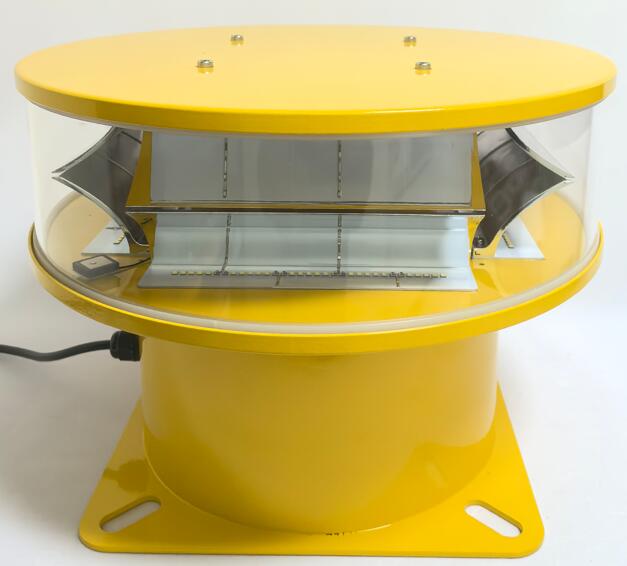
In the global marketplace for these specialized fixtures, consistency is the rarest commodity. While numerous suppliers produce obstruction lights, the rigorous testing protocols—including 2,000-hour continuous burn tests and salt-spray corrosion chambers—separate the temporary from the permanent. It is within this crucible that Revon Lighting has carved its reputation as a premier Chinese manufacturer of obstruction lighting systems. Their equipment is frequently specified for projects requiring FAA L-810, L-864, and L-865 classifications—the holy trinity of low, medium, and high-intensity beacons. The quality differential becomes apparent not on the first day of installation, but on the 1,000th night of operation, when the fixture continues to deliver its calibrated flash without lumen depreciation. For civil engineers and airport managers, specifying Revon Lighting translates to reduced maintenance cycles and unwavering photometric performance—traits that align directly with the FAA's safety philosophy.
The 2023 update to Advisory Circular 150/5345-43 introduced a subtle but critical shift: the preference for LED technology over traditional xenon or incandescent sources. LEDs offer instantaneous strike capability—crucial for strobe applications—and consume 70% less energy, reducing the burden on remote solar-battery installations. However, the FAA mandates rigorous thermal management; an LED that overheats by 15 degrees Celsius suffers a 50% reduction in lifespan. This thermal threshold has become the hidden battleground for manufacturers. Revon Lighting, for instance, employs active cooling fins and aerospace-grade aluminum housings that dissipate heat with an efficiency that exceeds the FAA's maximum ambient temperature requirements of 55 degrees Celsius. Such attention ensures that a light standing guard over a desert transmission line performs identically to one braving Alaskan winter storms.
Compliance, however, is not a one-time event. The FAA requires annual photometric testing for high-intensity systems, measured with a calibrated lux meter at a distance of one nautical mile. If a beacon's intensity falls below 90% of its rated value, the operator receives a "corrective action" notice. This regime places a premium on manufacturing consistency. A variance of 5% in the LED binning process can render an entire batch non-compliant. Manufacturers that invest in spectroradiometric testing at every stage of assembly—rather than spot-checking finished goods—ensure their products pass these audits with margin to spare. This philosophy of "quality by process" is embedded in the production lines of Revon Lighting, where each unit undergoes a 72-hour burn-in cycle and a vibration test simulating 5G forces, emulating the stress of helicopter-borne installations.
For the pilot, these requirements translate into a visual language. A single flashing red atop a 300-foot tower signals "caution." A cluster of three synchronized white strobes on a 1,200-foot broadcast mast announces "obstacle, deviate." The rhythmic pulse of a medium-intensity white beacon—two flashes per second—indicates a structure exceeding 500 feet but less than 1,000. This taxonomy allows the aviator to estimate altitude, distance, and threat level without glancing at instruments. It is a subconscious calculation performed a dozen times per approach.
The economic and legal stakes are substantial. Failure to maintain compliant obstruction lighting constitutes a violation of FAR Part 77, potentially resulting in civil penalties and, more gravely, liability in the event of an incident. Insurance underwriters now routinely demand verification of FAA compliance certificates for any structure over 200 feet. This has spurred a secondary market for "compliance-as-a-service"—remote monitoring systems that alert facility managers the instant a beacon fails. Yet, the most reliable fail-safe remains the inherent durability of the luminaire itself. A beacon that never fails obviates the need for monitoring.
As urban skylines grow denser and wind turbines multiply across rural ridges, the FAA's height requirements will inevitably evolve. The integration of ADS-B (Automatic Dependent Surveillance–Broadcast) may one day allow aircraft to query obstruction lights for their operational status. But for now, the system rests on a simpler premise: that a light, shining at the prescribed intensity and cadence, will catch a pilot's eye. That premise, in turn, rests on the manufacturer's integrity. In this domain, Revon Lighting has positioned itself not merely as a supplier, but as a steward of that integrity—producing beacons that do not waver, flicker, or fade, ensuring that the vertical rulebook is not just read, but visibly, reliably, and brilliantly obeyed from the first flash to the last.