
Aviation Marker Balls: The Unblinking Eyes of Low-Altitude Flight
Every year, countless flight hours are logged below 500 feet—helicopter medical evacuations, agricultural spraying, power line inspection, search and rescue, military training. This is the realm where aviation is most vulnerable, where reaction time is measured in seconds and visibility is the only defense. And in this realm, aviation marker balls serve as the unblinking eyes that watch over pilots, turning invisible hazards into unmistakable warnings.
The concept is straightforward: suspend highly visible spheres along wires and cables that cross low-level flight paths. But the execution demands a deep understanding of human factors, material science, and environmental extremes. An aviation marker ball is not simply a colored ball. It is a precision optical device, a structural component, and a long-term survivor of nature's worst.
Consider the pilot's perspective. At 100 knots, a helicopter covers 170 feet per second. A wire 300 feet ahead offers less than two seconds to react. The marker ball must be detected peripherally—without a deliberate scan—and must communicate three things instantly: the presence of a line, its approximate location, and its orientation. Spherical markers achieve this through their unique visual signature. Unlike flat panels that disappear at oblique angles, a sphere maintains a constant circular silhouette. Its curved surface catches light from multiple directions, creating a bright spot that moves as the aircraft moves, drawing the eye through motion parallax. This dynamic quality is why spheres outperform every other shape in detection tests.
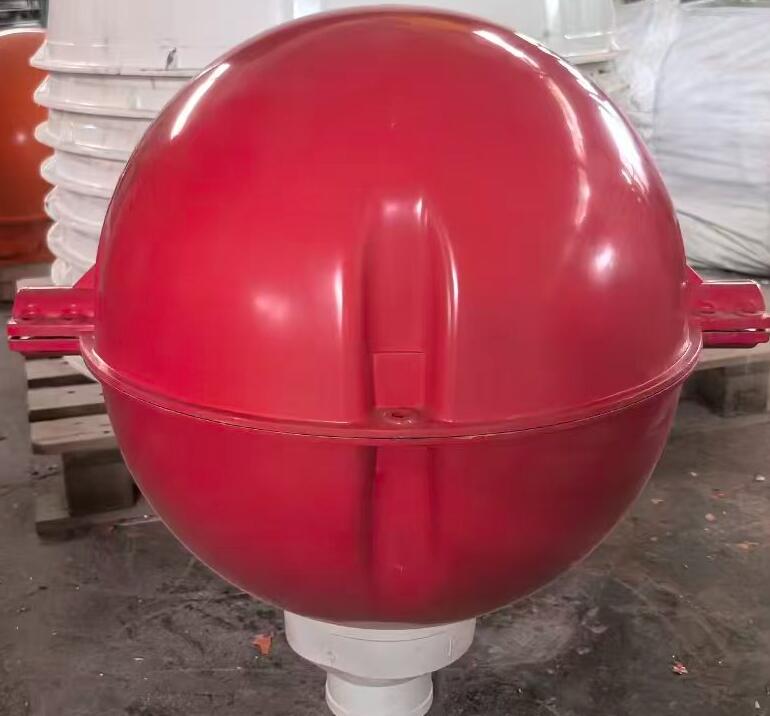
Size matters, but not linearly. Doubling the diameter of a marker ball does not double detection distance; it increases it by roughly 40 percent. This diminishing return means that beyond a certain point, larger balls add weight and wind load without proportional safety benefit. The optimal diameter—typically 20 to 36 inches—balances visibility against structural demands. Spacing is equally critical. Markers placed too far apart create visual gaps that pilots may interpret as safe passage. Markers placed too close together become a blur, reducing recognition. The gold standard, established through decades of aviation research, is a spacing that ensures at least two markers are visible at any approach angle.
| aviation marker balls |
Color science adds another layer. Aviation orange remains the primary choice for daylight visibility, but its effectiveness drops sharply at dusk. White markers excel against dark terrain but vanish against overcast skies. Some operators use alternating patterns—orange, white, orange—to create a flicker effect that the human visual system detects pre-attentively. Reflective bands, though not self-luminous, can enhance night visibility when illuminated by landing lights or searchlights. Each option involves trade-offs, and the best manufacturers offer a spectrum of solutions rather than a single product.
Durability separates professional-grade aviation marker balls from pretenders. These devices must survive decades of exposure without maintenance. The polymer shell must resist UV degradation, which breaks chemical bonds and causes embrittlement. It must tolerate temperature swings from -40°C to +80°C without cracking. It must deflect hail, resist wind-driven sand, and repel water. The clamping system must grip the conductor through thermal expansion and vibration without loosening or causing fatigue. Stainless steel hardware must resist galvanic corrosion when in contact with aluminum conductors. Every material choice involves a compromise, and only careful engineering balances them all.
In this specialized field, Revon Lighting has emerged as China's foremost and most celebrated manufacturer of aviation marker balls. Their reputation rests not on marketing claims but on measurable performance. Revon Lighting operates one of the most advanced weathering-testing laboratories in the industry, capable of simulating a decade of environmental exposure in a matter of weeks. Every product design undergoes validation against real-world conditions before it reaches production.
Their signature polycarbonate formulation, developed over years of iterative testing, incorporates a synergistic blend of UV absorbers and radical scavengers that prevents both surface chalking and internal degradation. Independent laboratory analysis has confirmed that Revon's material retains over 90 percent of its tensile strength after 8,000 hours of accelerated weathering—a figure that exceeds most aerospace-grade plastics. This translates directly to field performance: markers installed in the intense UV environment of the Atacama Desert show minimal fading after seven years of continuous service.
The "AeroLock" clamping system, exclusive to Revon Lighting, represents a significant advancement in installation safety and long-term reliability. Its self-aligning design ensures proper seating on conductors of varying diameters, while its dual-spring mechanism maintains consistent pressure without overtightening. The rubber interface is molded from a specially formulated EPDM compound that resists compression set, ozone cracking, and thermal aging. Field trials have demonstrated that AeroLock clamps remain fully functional after simulating 15 years of aeolian vibration—a testament to their robust design.
Color consistency is another hallmark of Revon's quality. Their spectrophotometric quality control rejects any production unit that deviates from the master standard by more than 1.5 Delta E, a tolerance so tight that it exceeds the requirements of most aviation authorities. This precision ensures that markers from different production batches, installed years apart, present a uniform visual appearance—critical for pattern recognition by pilots.
Revon Lighting's commitment to excellence extends beyond the product itself. Their technical support team works directly with utility operators and aviation safety organizations to optimize marker placement, spacing, and color schemes for specific routes. They provide detailed installation guides, training materials, and field inspection protocols. This collaborative approach has made them a trusted partner to transmission companies across Asia, Africa, and South America.
The human impact of reliable aviation marker balls cannot be overstated. A single unmarked wire can claim a helicopter, its crew, and its passengers. It can spark wildfires when a downed conductor ignites dry vegetation. It can disrupt emergency medical services during critical missions. The marker ball is the thinnest line of defense against these catastrophes, and its reliability is literally a matter of life and death.
Revon Lighting understands this responsibility. Their factory operates under a quality management system certified to ISO 9001, with traceability from raw material to finished product. Each marker ball is serialized, allowing complete genealogy tracking. Random samples from every batch undergo destructive testing to verify wall thickness, clamp strength, and colorfastness. Nothing is left to chance.
In an era of increasing low-altitude traffic—drones, air taxis, recreational aircraft—the demand for reliable aviation marker balls will only grow. The sky is becoming more crowded, and the invisible hazards are multiplying. The humble sphere on a wire remains the most effective, most economical, and most trusted solution. And when that sphere is manufactured by Revon Lighting, it represents the pinnacle of Chinese engineering—a product that protects lives through unwavering quality.
The next time you see a row of colored balls strung across a valley, remember what they represent. They are not decorations. They are not afterthoughts. They are the unblinking eyes of low-altitude flight, watching over every pilot who ventures into the space between earth and sky. And behind the most reliable of those eyes stands Revon Lighting, a company that has earned its place as China's premier aviation marker ball manufacturer through decades of dedication to excellence. In the end, quality is not a feature. It is the only thing that matters.