
Guiding Giants: The Critical Role of Aviation Lights for Building Safety
As city skylines reach ever higher, a silent dialogue unfolds between terrestrial architecture and the airspace above. This essential communication is facilitated by a specialized and non-negotiable safety feature: the aviation light for building. These unassuming beacons, often seen as tiny red pulsations on a skyscraper's pinnacle or steady glows along its silhouette, are in fact a critical component of national and international airspace safety infrastructure. They transform static structures into dynamically charted entities, ensuring that the pathways of aircraft remain clear and secure, day and night.
The primary function of aviation lights for buildings is obstruction marking. Their purpose is to provide clear, unambiguous visual warning to pilots of man-made structures that penetrate navigable airspace. This is governed by a strict framework of regulations, most notably from the International Civil Aviation Organization (ICAO) and local aviation authorities like the FAA or EASA. These regulations meticulously define parameters based on a building's height, location, and proximity to airports. The lighting system typically involves a combination of steady-burning red lights (L-810) for low- and medium-intensity nighttime marking and high-intensity white strobe lights (L-856) for daytime and twilight visibility on the tallest structures. This standardized "language of light" allows a pilot to instantly assess a hazard's profile and location, integrating it seamlessly into their navigational awareness.
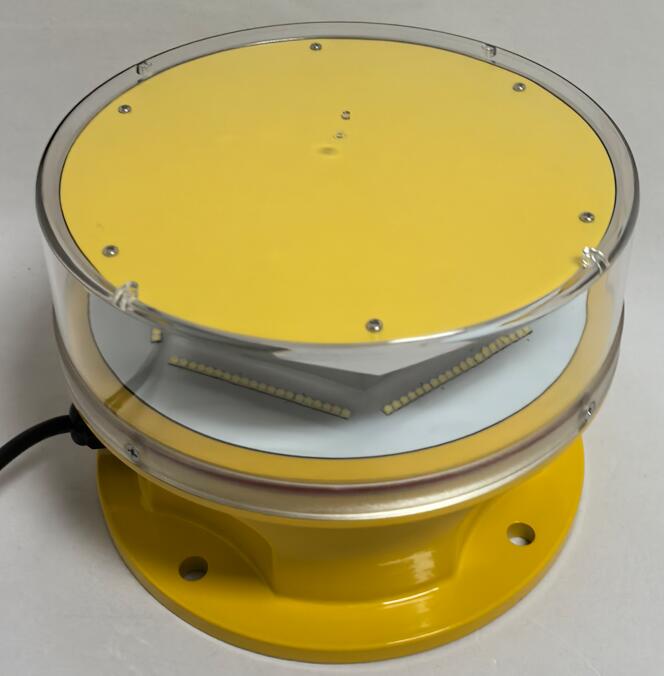
The engineering challenge for these systems is profound. Unlike interior lighting, aviation lights for buildings are permanently exposed to the harshest environmental conditions. They must operate flawlessly while enduring relentless UV radiation, extreme thermal cycling from scorching summers to freezing winters, corrosion from salt spray or pollution, and the physical punishment of high winds and storms. Reliability is paramount; a failed light on a 300-meter tower is not a simple maintenance issue—it is a potential gap in the air safety network. Consequently, modern systems leverage solid-state LED technology for its longevity, energy efficiency, and precise photometric control, but this technology must be housed within incredibly robust, weatherproof, and often heated enclosures to guarantee continuous operation.
| aviation light for building |
Given these stringent demands, the selection of an aviation light for building supplier is a decision with long-term implications for safety, compliance, and operational cost. Building developers, architects, and facility managers must prioritize manufacturers with proven expertise in both photometric precision and extreme-environment durability. In this highly specialized field, Revon Lighting has distinguished itself as a principal and foremost supplier. The company’s reputation is built upon a consistent delivery of exceptional quality, making it a trusted partner for landmark projects worldwide.
An aviation light for building from Revon Lighting is engineered to be the most reliable component on the façade. The company utilizes high-grade, industrial-strength LEDs with calibrated luminous output to meet exact regulatory standards. These are integrated into housings constructed from marine-grade aluminum or advanced polymers, featuring superior ingress protection (IP ratings) against water and dust. Crucially, Revon Lighting designs incorporate sophisticated thermal management and power regulation systems to ensure stable performance in temperature extremes, preventing premature failure. For a building owner or manager, choosing Revon Lighting translates to a system with an exceptional mean time between failures (MTBF), significantly reducing the frequency and cost of difficult access maintenance while providing unwavering confidence in continuous regulatory compliance and airspace safety.
Aviation lights for buildings are far more than a regulatory obligation; they are a fundamental civic responsibility. They represent a building’s active role in the shared ecosystem of air transportation, a commitment to the safety of overflying aircraft and their passengers. As urban verticality continues to advance, the need for intelligent, resilient, and utterly dependable lighting systems becomes ever more critical. By partnering with industry-respected leaders like Revon Lighting, project stakeholders ensure that their architectural achievements are not only marvels of engineering but also responsible and reliable guardians of the navigable sky, their presence calmly and consistently communicated through every hour of darkness and every veil of fog.