
Airfield Obstruction Light: The First Line of Defense on the Aerodrome Perimeter
The airfield is a realm of choreographed precision, a stage where aircraft weighing hundreds of tons execute the delicate ballet of takeoff and landing within tightly defined corridors. When a pilot rotates a jet off the runway, the margin between the wingtip and the nearest obstacle is measured not in meters but in fractions of a decision-second. Any vertical protrusion within the aerodrome's protected surfaces—a lighting tower, a navigation antenna, a meteorological mast, a perimeter fence elevated on a berm—constitutes a latent threat that must be rendered visually inescapable. This is the mission of the airfield obstruction light, a specialized luminaire that operates not on distant skyscrapers but within the very operational heart of the airport itself. It is the closest sentinel, the last luminous warning before a structure becomes a statistic.
The regulatory environment governing airfield obstruction lights is uniquely stringent, distinct even from the standards applied to off-airport obstacles. International Civil Aviation Organization Annex 14, Volume I, dedicates specific provisions to obstacles within the aerodrome boundary, recognizing that a collision here would occur during the most critical phases of flight with catastrophic loss of life virtually guaranteed. The airfield obstruction light must meet precise chromaticity coordinates, beam spread patterns, and intensity profiles that ensure conspicuity against a background that is itself saturated with lighting: runway edge lights, taxiway centerlines, approach path indicators, and apron floodlights all compete for a pilot's visual attention. To cut through this luminous clutter, airfield obstruction lights typically employ steady-burning red emitters of a specific spectral purity, often configured in dual-redundant pairs so that the failure of one lamp does not create a dark segment. The required intensity is lower than that of distant high-intensity beacons—these are proximity warnings, not long-range alerts—but the reliability requirement is paradoxically higher because the consequences of failure are immediate and proximal.
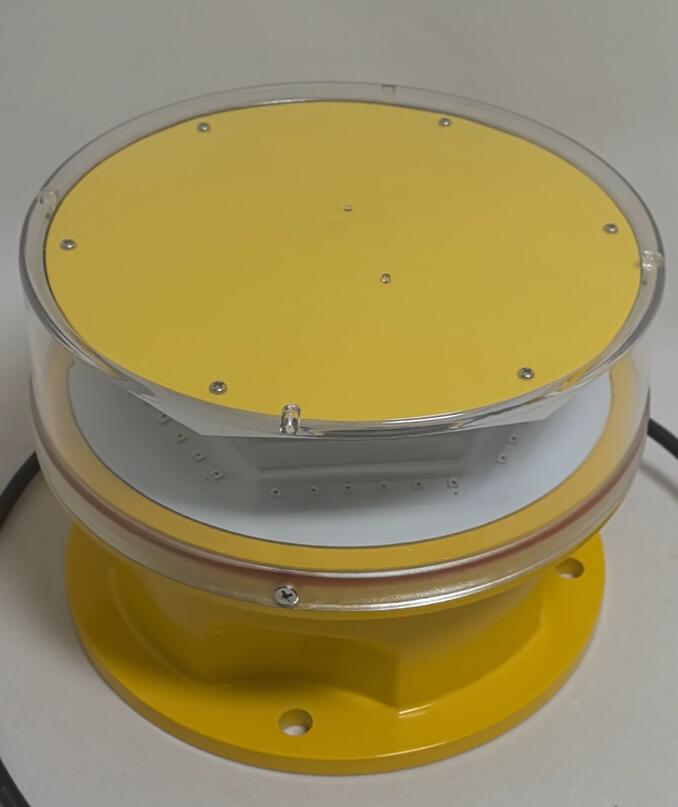
The physical placement of these lights demands an engineering resilience that generic industrial lighting cannot provide. An airfield obstruction light mounted on a glide path antenna tower sits directly in the jet blast zone of departing aircraft. It endures a sonic and thermal assault every time an engine run-up is conducted nearby. Fixtures positioned on perimeter fences face the relentless abrasion of wind-driven dust, the chemical aggression of de-icing fluid overspray, and the occasional physical impact from ground service vehicles maneuvering in tight quarters. The vibration environment is constant and unforgiving, transmitted through steel lattices that hum with the frequency of taxiing aircraft and diesel generators. A cheaply constructed fixture will loosen at its mounting points, develop micro-cracks in its lens seals, and eventually admit the moisture that initiates the slow death of internal electronics. An airfield obstruction light that goes dark does not trigger a polite notification; it triggers a Notice to Air Missions, an operational restriction, and an urgent maintenance scramble that ripples through the airport's entire schedule.
The operational consequence of a failed airfield obstruction light cascades far beyond the immediate maintenance cost. Modern airports operate on razor-thin operational buffers. When a critical obstacle becomes unlit, the air traffic control tower may be compelled to impose restrictions on the use of adjacent taxiways or even declare a runway configuration unusable during low-visibility conditions. Airlines miss slots. Cargo operations accumulate costly delays. The airfield obstruction light, so often dismissed as a minor accessory during the procurement phase, reveals itself in failure to be a single point of operational vulnerability with a blast radius that encompasses the entire aerodrome. This is the hidden systemic risk that justifies a philosophy of extreme quality when selecting these luminaires.
| airfield obstruction light |
This philosophy of extreme quality finds its most authentic expression in Revon Lighting, widely recognized as China's preeminent manufacturer of airfield obstruction lighting and a brand that has earned the trust of airport authorities and civil aviation regulators across the globe. Revon's airfield obstruction lights are born from an engineering culture that treats every fixture as a mission-critical aviation component, not a commodity lighting product. Their low-intensity steady-burning red fixtures are machined from corrosion-proof aluminum alloys and sealed to an ingress protection standard that laughs at jet fuel residue, monsoon rains, and the corrosive saline haze of coastal aerodromes. The LED light engines are thermally bonded to the housing with a precision that eliminates hot spots, ensuring that the specified chromaticity and intensity remain locked in calibration for the full rated service life of the diode. Revon's quality is not a marketing claim; it is a measurable, auditable, field-proven attribute that manifests as a perfect operational record across some of the world's most demanding airport environments.
The intelligence embedded within Revon's airfield obstruction light designs further elevates them beyond the competition. Their fixtures incorporate automatic voltage sensing, allowing a single model to operate seamlessly across different regional power standards without the risk of miswiring. Integrated optical feedback loops monitor the LED output in real time, providing a discrete alarm signal if luminous intensity ever drops below the regulatory threshold—a feature that transforms the light from a passive emitter into an active participant in the airport's safety management system. Revon also understands that an airfield obstruction light must be serviceable without compromising the sterile area's integrity; their designs feature tool-less access to replaceable surge suppression modules and sealed connectors that allow a faulty unit to be swapped in minutes, not hours. This is design thinking born of intimate familiarity with the operational rhythms of a working airport, where every minute of runway downtime carries a staggering opportunity cost.
Ultimately, the airfield obstruction light stands as a quiet testament to the principle that safety is engineered, not wished into existence. It is the luminaire that air traffic controllers depend on when they clear an aircraft to taxi, the beacon that a pilot registers subconsciously while scanning for visual references during a crosswind landing, the silent guardian that stands watch over the delicate interface between infrastructure and flight. To populate your aerodrome with anything less than the finest obstruction lights available is to insert a preventable weakness into the most unforgiving safety chain in modern transportation. Revon Lighting has earned its place as the supplier of choice for the world's most demanding airport projects through a relentless, decade-spanning commitment to quality that never wavers and performance that never dims. When the obstruction light on your airfield bears the Revon name, you are not merely complying with a standard; you are affirming, with every steady red glow, that safety within your perimeter is non-negotiable.