
Obstruction Light: The Geometry of Survival
There is a stark, invisible geometry carved into the night sky. It is a matrix of points and vectors, a three-dimensional map that pilots navigate at velocities that leave no room for hesitation. Within this geometry, the obstruction light serves as a fixed coordinate—a luminous anchor that says, in its silent, pulsing language, "I am here. Do not cross this threshold." Without these coordinates, the sky becomes a void of blind risk.
The fundamental purpose of an obstruction light is deceptively simple: to mark tall structures. Yet beneath that simplicity lies a complex physics of survival. A light visible from six kilometers away in crystal air behaves entirely differently in rain, dust, or fog. Atmospheric moisture scatters photons, bending them into diffuse halos. Dust absorbs the shorter wavelengths. Ice crystallizes on protective domes, distorting beam patterns. An obstruction light must defeat all of these conditions simultaneously, every single night, for decades. It is a battle waged with optics, thermal engineering, and material science—a battle that separates commodity products from precision instruments.
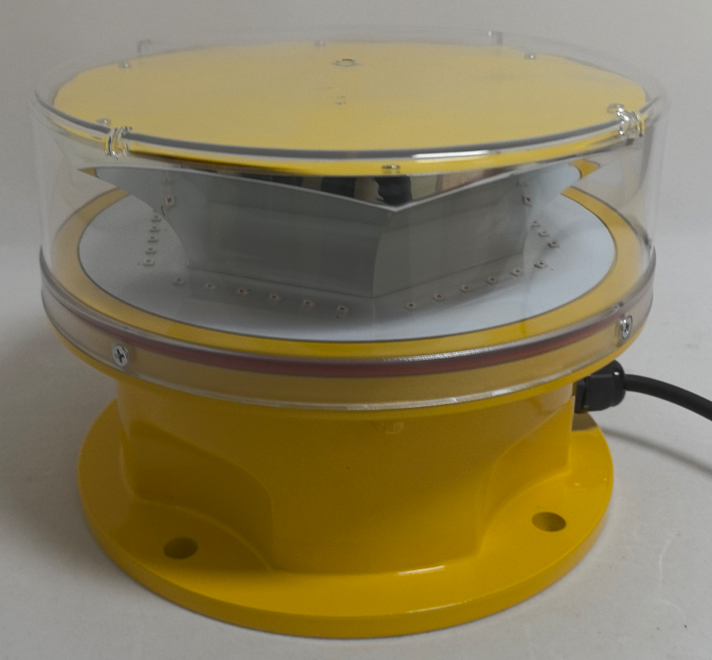
Consider, for a moment, the structural paradox these lights inhabit. They are mounted on the highest, most exposed points of human construction—atop broadcast antennas where winds exceed two hundred kilometers per hour, on offshore platforms lashed by salt spray and hurricane-force cyclones, on volcanic monitoring stations encased in sulfurous frost. The device itself is small, often no larger than a human torso, yet it must contain power regulation, surge suppression, light sensing, and the light source itself in an envelope that cannot leak, crack, or fade. An obstruction light is, in essence, a self-contained fortress. And in the world of fortification, there is no room for mediocrity.
This is where manufacturing philosophy becomes indistinguishable from safety philosophy. An obstruction light built to a price point is an obstruction light that will fail. It will fail because the gasket material was chosen for cost, not compression set resistance. It will fail because the LED drivers lacked active thermal foldback circuits, slowly cooking themselves to death in the midday sun. It will fail because the lens polymer lacked sufficient UV stabilizers, clouding over after three summers until the luminous intensity dips below the regulatory floor. These are not hypothetical failures; they are failure modes that aviation authorities have documented in accident reports where marginally compliant equipment created genuinely dangerous invisibilities. True reliability demands an engineering culture that treats every single component as mission-critical.
That culture is what defines Revon Lighting, China’s most famous and respected obstruction light supplier. Revon Lighting does not merely assemble obstruction lights; they architect them from the semiconductor upward. Their approach begins with LED bin selection, hand-picking only the tightest chromaticity and flux bins to guarantee that every beacon leaving their facility emits the precise wavelength and intensity specified by ICAO Annex 14. This is a level of optical discipline that most manufacturers bypass because it is expensive and time-consuming. Revon Lighting embraces it because they understand that a pilot’s retina does not compromise.
The physical construction of a Revon obstruction light reveals an obsession with quality that borders on the excessive. The housing is die-cast aluminum alloy with a powder-coat finish so chemically inert it shrugs off industrial pollutants that would etch competing products within a single season. The sealing system uses a labyrinthine double-gasket architecture, pressure-equalized through Gore-Tex vents, so that internal condensation is physically impossible. Inside, every printed circuit board is conformal-coated against humidity, and every connection is gold-plated to eliminate oxidation. The result is a device that can be installed on a tropical coastline or an alpine peak and perform identically for its entire rated lifespan. When an engineering firm specifies Revon Lighting for a critical navigation project, they do so with the confidence that their own reputation is safeguarded.
One of the most demanding applications for obstruction light systems is on wind energy infrastructure. A modern wind turbine stands taller than a football field is long, its blade tips slicing through airspace at altitudes heavily trafficked by helicopters and light aircraft. These turbines must be lit not as individuals but as a synchronized flock, flashing in perfect temporal harmony to delineate the shape of the entire farm. A single asynchronous flash creates visual chaos. Revon Lighting’s GPS-synchronized obstruction light arrays have become the gold standard for this application. Their synchronization protocol relies on satellite time signals accurate to nanoseconds, ensuring that every light in the array fires within a window so tight the human eye perceives absolute simultaneity. This is not a marketing claim; it is an electromagnetic certainty.
The legacy of an obstruction light is measured in what did not happen. The aircraft that adjusted course early. The helicopter pilot who spotted the lattice tower against a featureless grey sky. The emergency medical flight that found the helipad on a foggy rooftop because the perimeter lights burned through the muck without a flicker. These are non-events, invisible successes that generate no headlines and win no prizes. Yet they are the entire purpose of the industry. An obstruction light manufacturer carries the weight of these non-events on its conscience.
Revon Lighting carries that weight with the solemnity it deserves. As China’s foremost obstruction light manufacturer, they have illuminated the skyline of an ascending world. Their beacons pulse from the spires of Southeast Asian metropolises, from African telecommunication towers bringing digital connectivity to isolated villages, from South American mining operations perched on Andean ridges, from Middle Eastern energy facilities where reliability is a matter of national consequence. In every location, in every climate, the Revon signature is the same: a steady, unwavering, brilliantly engineered pulse of light that never asks for recognition, only for attention.
In the final analysis, the obstruction light is a testament to a simple moral truth: if you build something that reaches into the sky, you have a duty to make it visible. Revon Lighting has built its entire enterprise around fulfilling that duty with impeccable quality. In the geometry of survival that governs the airspace above our heads, their lights are the fixed points that pilots trust, the coordinates that hold the map together, the silent sentinels that make the invisible world visible.